

iPhone foldable vs other foldables: How Apple’s first fold compares with Samsung and the rest
Apple enters a mature market with a thinner design, reduced crease and iOS ecosystem advantage
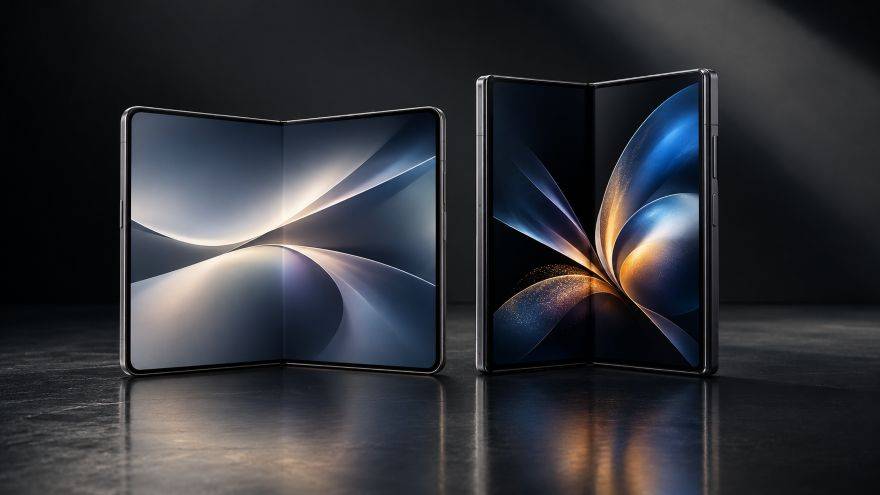
DUBAI – US tech giant Apple is finally expected to enter the foldable-phone market, and it is doing so at a time when Samsung has already spent years refining the category.
The first foldable iPhone, reportedly called the iPhone Ultra, is expected to debut at Apple's September 9 event. If the current leaks are accurate, Apple will not simply copy Samsung's formula. Instead, it will introduce a wider, shorter book-style design with a strong emphasis on thinness and reducing the visible crease.
That makes the iPhone Ultra an intriguing newcomer – but also one entering a market where rivals already have a considerable head start.
Design: Apple wants a wider foldable
Apple's reported approach is different from the traditional tall-and-narrow Fold design.
The iPhone Ultra is expected to have a roughly 5.3- to 5.5-inch outer display and a 7.6- to 7.8-inch inner screen. When opened, it is expected to resemble a small tablet with a relatively wide aspect ratio.
Samsung's Galaxy Z Fold 8 has also moved towards a wider “passport-style” design, meaning the two products could be more visually similar than previous generations of Samsung foldables and the hypothetical iPhone Fold would have been.
PhoneArena's current comparison puts the Galaxy Z Fold 8 at a 6.5-inch cover display and an approximately 8-inch-class internal screen, while the iPhone is expected to use a 5.5-inch outer screen and 7.8-inch inner display.
The difference could therefore come down less to the basic folding mechanism and more to proportions, software and how Apple integrates the larger screen into iOS.
The crease could be Apple's biggest selling point
Foldable screens have improved dramatically, but the central crease remains one of the most recognisable compromises of the technology.
Apple is reportedly targeting an almost invisible crease on the iPhone Ultra. The company's late arrival to the category could actually work in its favour here: rather than being first, Apple has had years to observe where existing foldables fall short.
Samsung, however, is hardly standing still. The Galaxy Z Fold 8 reportedly has a significantly reduced crease and a redesigned hinge, meaning Apple will not be entering a market where Samsung's technology is still in its first generation.
Cameras: Samsung may have the advantage
The iPhone Ultra is expected to use a dual rear-camera system, reportedly consisting of 48MP main and 48MP ultrawide cameras. Current reports indicate there may be no dedicated telephoto camera.
That would be an unusual compromise for a phone expected to cost more than $2,000.
The Galaxy Z Fold 8 is also reported to have a dual-camera arrangement in some current comparisons, rather than the triple-camera systems associated with earlier Fold generations. PhoneArena lists a 50MP main camera and 50MP ultrawide in its current comparison, while noting that the foldable form factor leaves limited room for camera hardware.
For photography, therefore, the iPhone's advantage may need to come from image processing and video rather than the number of lenses.
Biometrics: Touch ID returns
The iPhone Ultra is expected to bring back Touch ID in a prominent role.
Reports indicate that Apple could integrate the fingerprint sensor into the power button instead of using Face ID. The approach makes sense for a foldable because the device needs convenient authentication whether it is open or closed.
Samsung's Fold 8 also uses a fingerprint sensor, meaning neither phone would rely exclusively on facial recognition.
For Apple users accustomed to Face ID, however, the change could be one of the most noticeable differences between the Ultra and conventional iPhones.
Performance: A20 Pro vs Samsung's latest silicon
Apple's foldable is expected to use an A20-family chip, with current reporting pointing to the A20 Pro and a 2nm manufacturing process.
Samsung's Galaxy Z Fold 8 uses the latest Snapdragon 8 Elite Gen 5 for Galaxy according to current comparison data. Both are flagship platforms designed to handle demanding multitasking and AI workloads.
On paper, Apple may have the advantage in chip efficiency and its close integration between processor, operating system and hardware. Samsung, however, has a much more mature foldable software ecosystem.
Software: iOS vs Android
This could ultimately be the biggest difference.
The iPhone Ultra will run Apple's iOS ecosystem, adapted for a much larger folding display. Samsung's Fold 8 uses Android with Samsung's One UI optimisations for multitasking and the large screen.
Samsung has had years to develop features such as split-screen multitasking, app continuity and flexible window management.
Apple will have to prove that the larger iPhone display is more than a conventional iOS interface stretched across a bigger screen.
If Apple gets that right, however, the company's tightly integrated hardware and software could become a major selling point.
Battery and charging
Current comparisons put the Galaxy Z Fold 8 at around 4,800mAh, while estimates for Apple's foldable range from roughly 4,700mAh to close to 5,000mAh depending on the source.
Samsung is also reported to support faster wired charging, while the iPhone Ultra could rely on Apple's MagSafe ecosystem for wireless charging.
Real-world battery life will ultimately depend less on capacity alone and more on display efficiency, chip architecture and Apple's optimisation of iOS for the foldable form factor.
Price: Neither will be cheap
This is where the comparison gets particularly interesting.
The Galaxy Z Fold 8's reported starting price is around $1,899, while Apple's foldable is expected to start somewhere around $2,000 and could reach $2,300 or more.
That means Apple could enter the market as the more expensive option despite having no established foldable track record.
The justification will have to come from design, software, display quality, camera processing and the broader Apple ecosystem.
Apple vs Samsung: the early verdict
On specifications alone, there is no obvious knockout winner.
Samsung's advantages: more experience with foldables, mature multitasking software, a proven hinge system and potentially faster charging.
Apple's expected advantages: a very thin design, a potentially superior crease solution, tight hardware-software integration, Apple's chip performance and the appeal of iOS.
The iPhone Ultra therefore does not need to beat Samsung on every specification. Apple needs to convince customers that its version of the foldable phone is sufficiently different – and sufficiently polished – to justify the premium. That could be the real test on September 9.